Shopper browses your shop
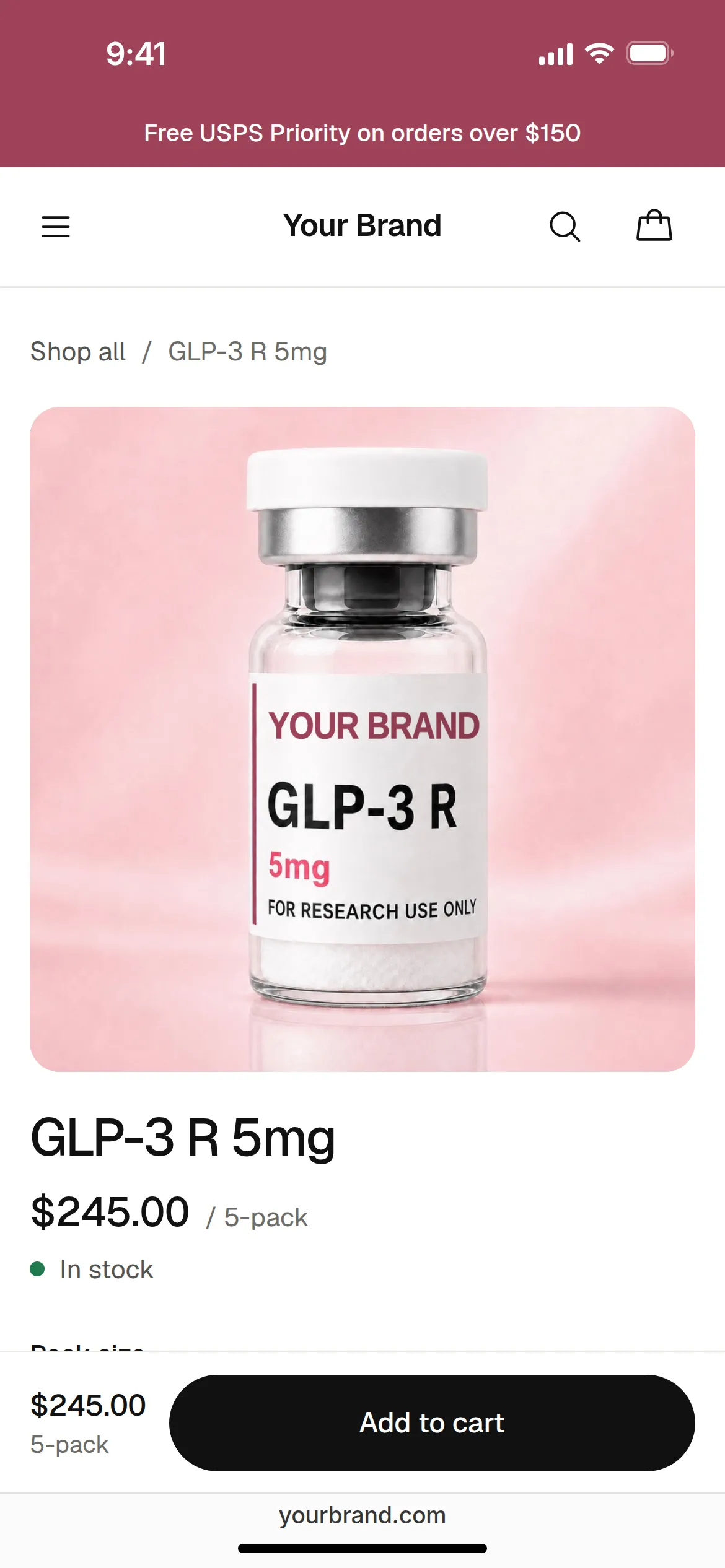
Your peptide website store opens at your own domain, with your name, your colors and our catalog at your prices.
 Lotus Peptide Partners
Every application is reviewed.
Where research peptides can be sold online, which platform rules apply, and the ways shoppers can pay you at checkout.
Watch the 1-minute tour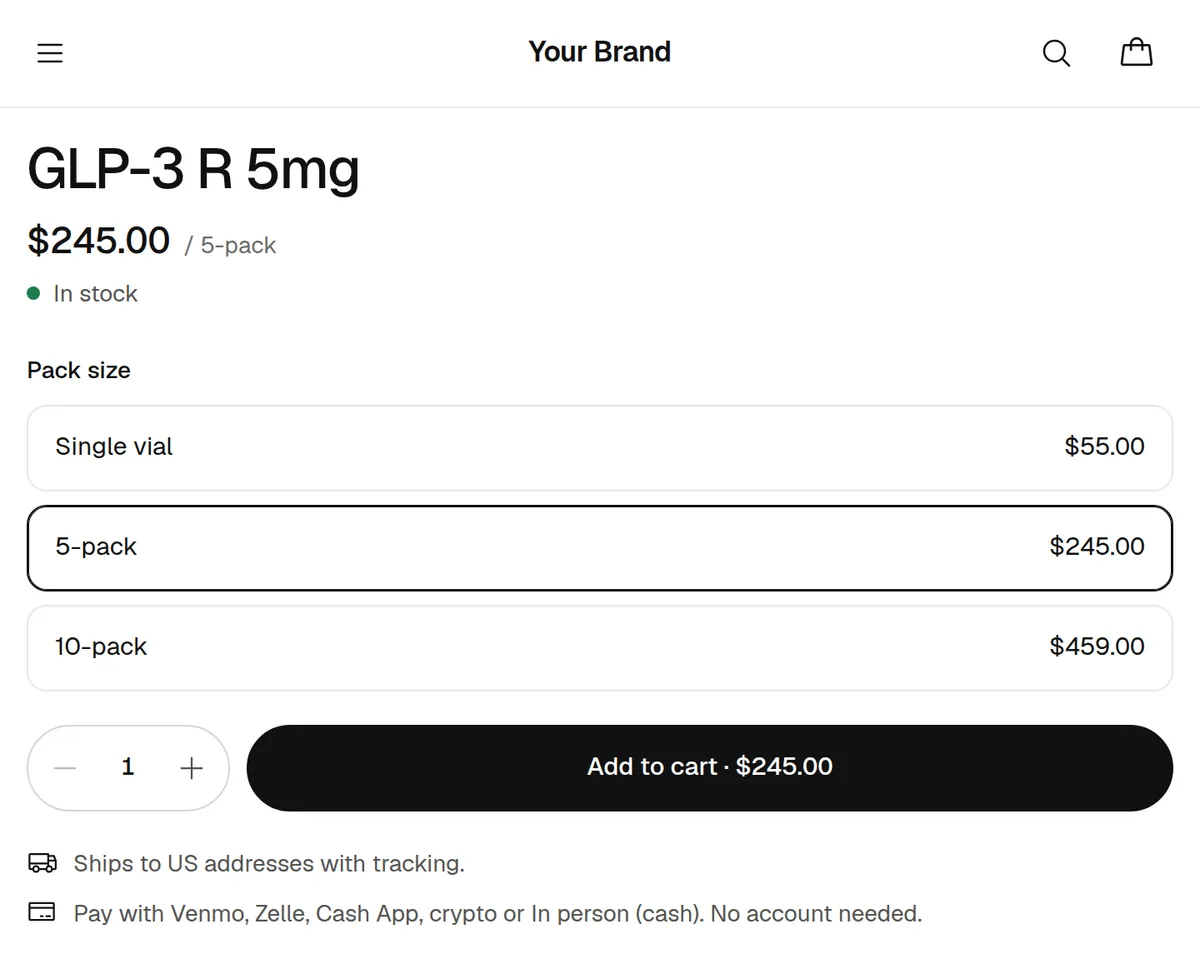
To sell peptides online you need four things: a store that accepts research products, a way for shoppers to pay you, someone to pack and ship each order, and descriptions written for laboratory research use only. One workable setup is a store on a domain you own, payment by methods such as Venmo, Zelle or crypto, and social posts that send buyers to that store's link.
You need a store that will list research products, a way to take payment that allows them, someone to pack and ship each order, and product descriptions that stay within research use.
The store is usually the hard part. Many hosted platforms and payment processors limit research products, which is one reason to sell from a store you control, on a domain you own.
Without a card processor, small sellers take money person to person, by app transfer, crypto or cash, and someone confirms each payment arrived before the order moves on.
Then the physical side: stock, labeled vials, packing, a postage label and tracking. You can do it yourself, hire a third-party logistics company (a 3PL), or use a supplier that ships for you, which is how peptide dropshipping works.
Last, the words: each listing says what the product is, its packs and its price, and nothing about how to use it.
Five common routes, side by side. Each platform sets its own rules and revises them, so read its current policy before you build there.
| Channel | Who sets the rules | Can you take payment there? | Who owns the customer | What to check first |
|---|---|---|---|---|
| Your own store on your domain | You, within the terms of the payment methods you use | Yes, by the methods you turn on | You: the order and the buyer's details | An age check, a research-use notice and plain product descriptions |
| Online marketplaces | The marketplace | Only through its own checkout, if it accepts the listing | Largely the marketplace | Its current policy on research products; each one sets its own |
| General store builders | The builder and the payment processor behind it | Through the payment options it supports, under their rules | You, while your account stays open | Its current policy and its payment provider's restricted list |
| Social media and messaging apps | The app | Not in the app: share your store's link and the buyer pays at your checkout | The app holds the audience; the order is yours | Its current rules on promoting research products and posting links |
| Selling to other shops through your checkout | You | Yes, at your own checkout, like any other order | You | That every buyer orders at your checkout and agrees to research use only |
Because the platform or processor carries the risk when a product is mislabeled, sold for the wrong purpose or regulated, many limit whole categories instead of judging each seller one by one.
Card processors publish their own lists. Stripe, for example, lists incorrectly labeled research chemicals among the businesses it prohibits and restricts prescription-only products. A store builder that runs on a processor like that inherits its limits, even where the builder itself would host the listing.
Marketplaces and social apps write their own policies and change them, so read the current one yourself before you put time or money into a platform.
Your listings matter as much as the channel: a research product described with directions or promised effects reads as something else. This is general information, not legal advice; check with a lawyer.
One order from your shopper’s side, in the Your Brand example shop.
Your peptide website store opens at your own domain, with your name, your colors and our catalog at your prices.
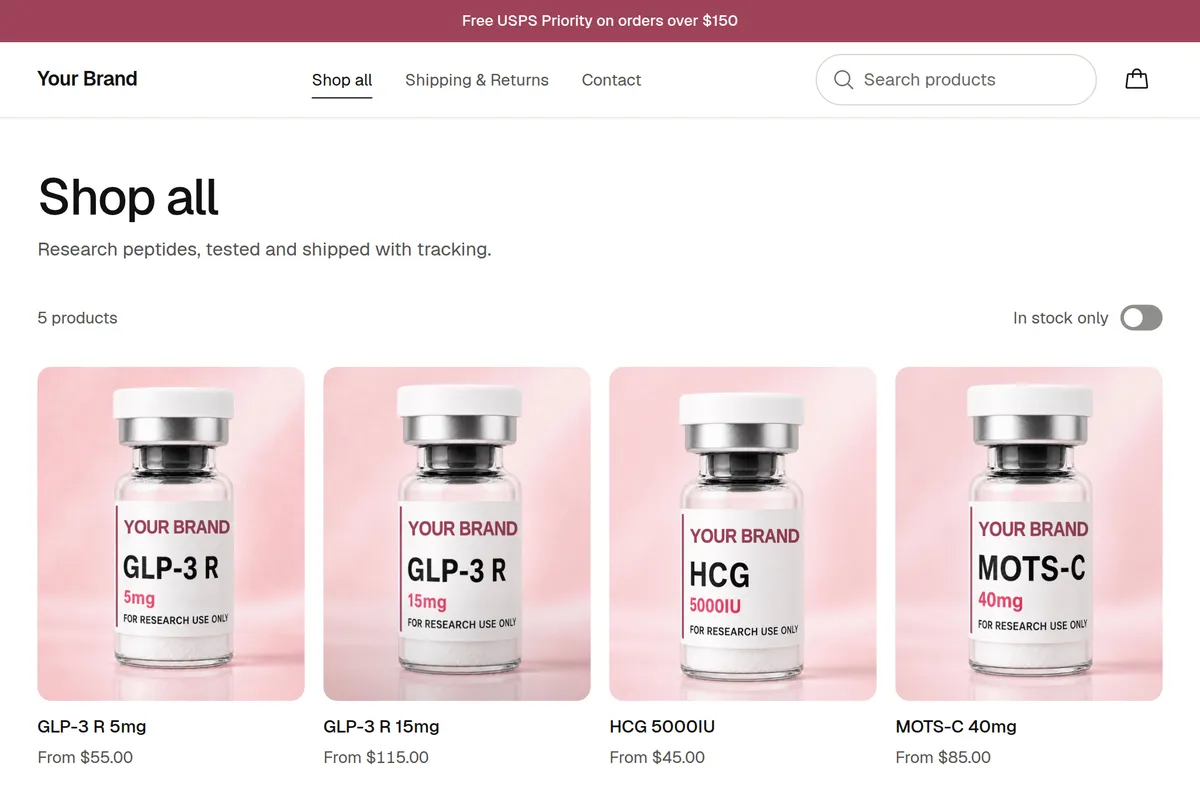
They pick a pack size and quantity, and the cart shows the subtotal and a Check out button.
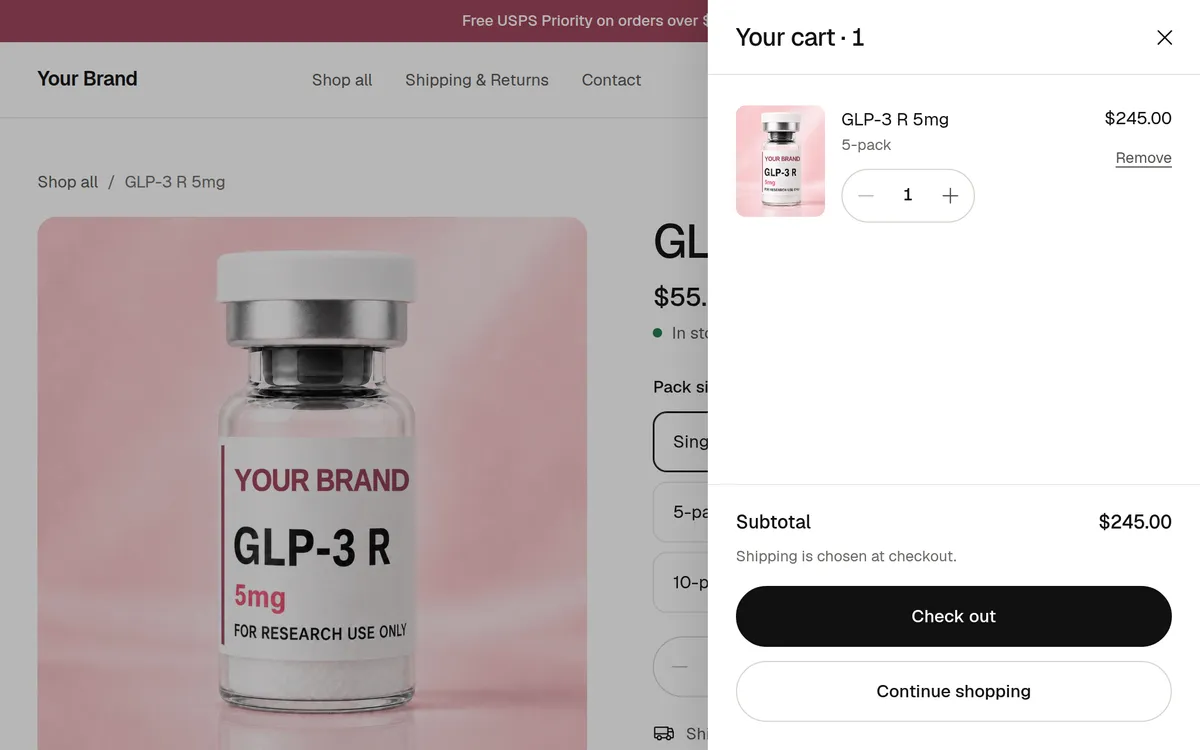
Checkout offers the payment methods you switch on, and the money goes straight to you, never through us.
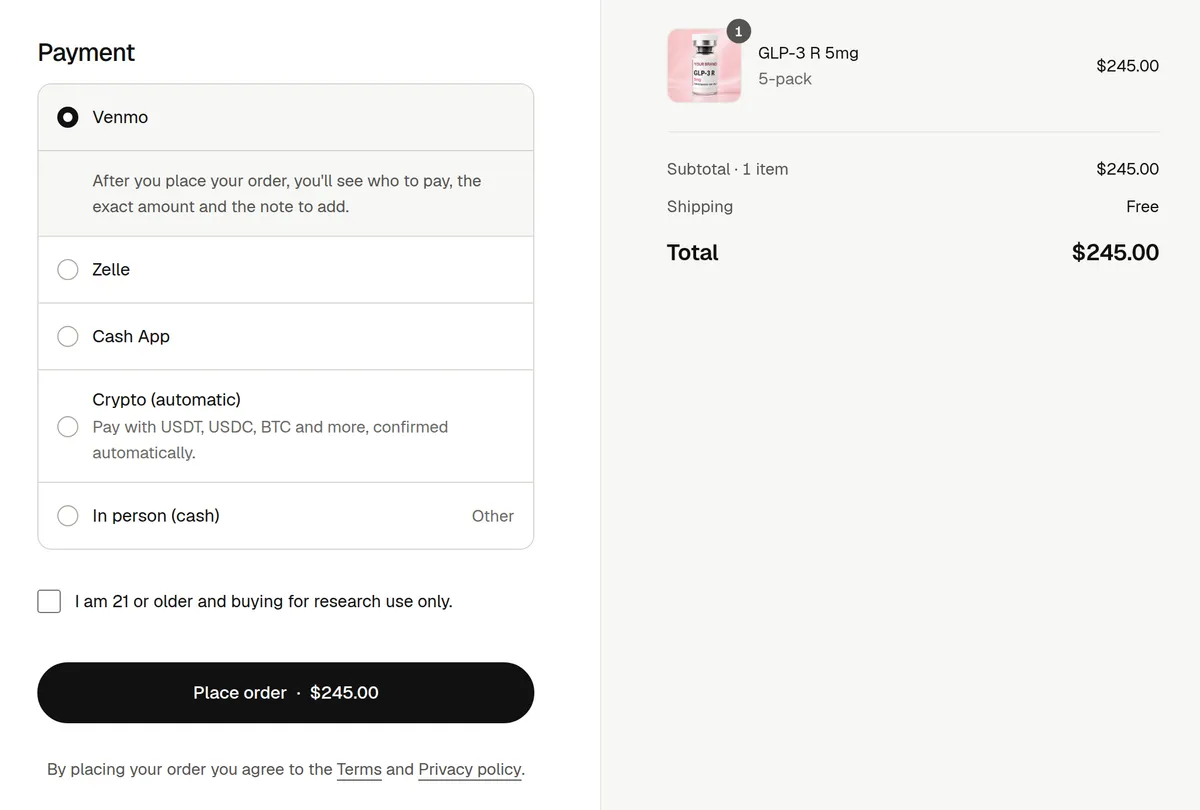
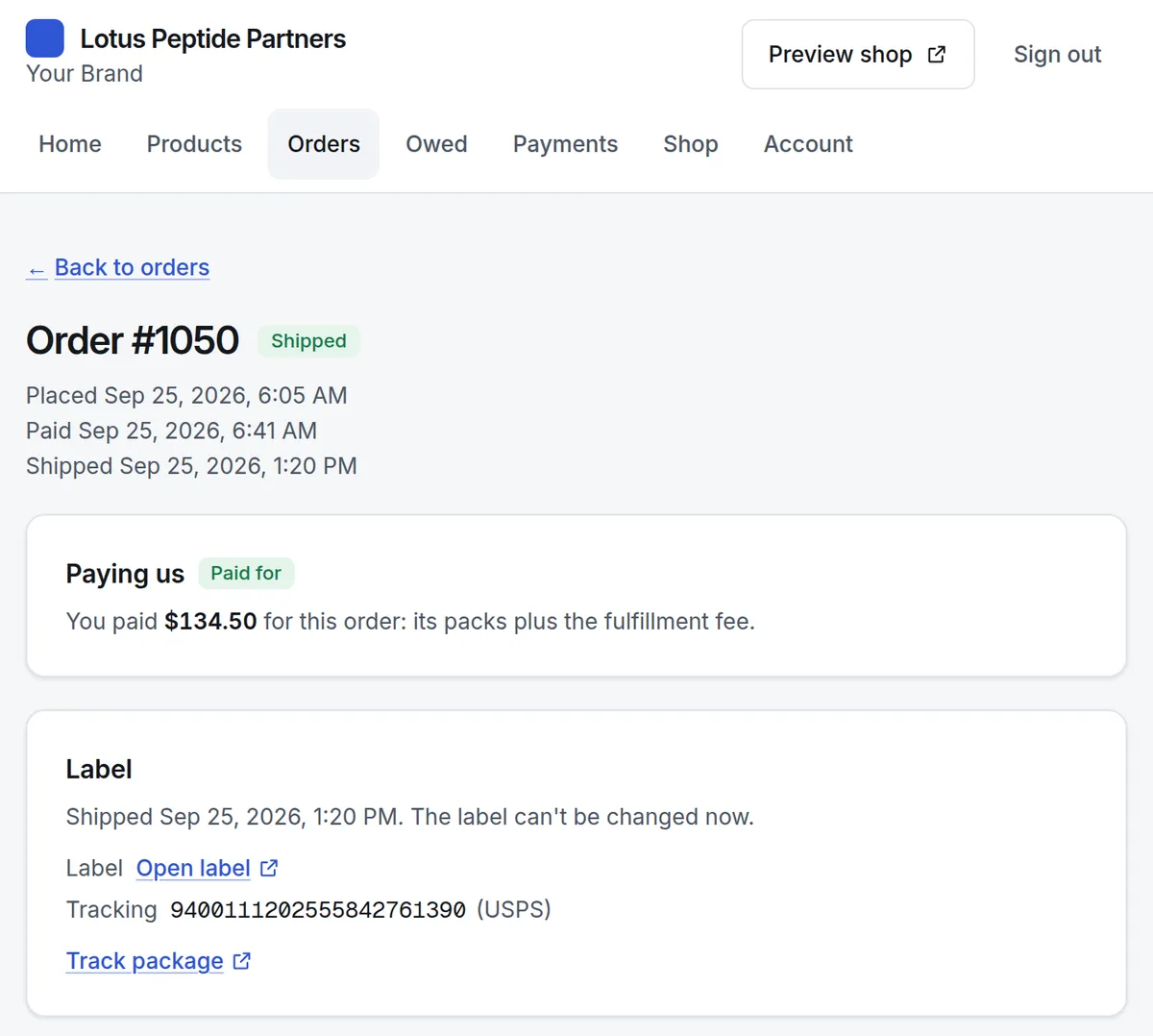
Their vials arrive with your label, in a package with your brand, and your shop emails them the tracking number.
Shoppers pay you directly, by the methods you turn on in your panel. Card payments aren't available yet.
| Method | How the shopper pays | How the order is marked paid |
|---|---|---|
| Venmo | Sees who to pay and the exact amount, then pays in Venmo | You, when the money arrives |
| Zelle | Sees your Zelle details and the exact amount, then pays | You, when the money arrives |
| Cash App | Sees where to pay and the exact amount, then pays in Cash App | You, when the money arrives |
| PayPal | Sees where to pay and the exact amount, then pays by PayPal | You, when the money arrives |
| Crypto sent by hand | Sees where to send it and the exact amount, then sends it | You, once it reaches you |
| Cash in person | Hands you the cash | You, once it is in your hand |
| Automatic crypto (your own NOWPayments account) | Pays at checkout through your NOWPayments account | Confirmed on its own, so the order moves to paid |
| Cards | Not available yet | Not available yet |
Shoppers get an order confirmation when they order and a shipping email with the tracking number once the package is on its way, both from an address on your own domain.
They go out through your own Resend account, an email sending service you connect in your panel, so they carry your shop's name.
Each order also has its own page showing how to pay, how far the order has gotten and, once it ships, its tracking.
Tracking starts with the postage label: you buy it on Pirate Ship, a postage site, see the price first, and paste the label link and tracking number into the order.
It needs an age check for visitors, a research-use notice, a clear name, packs and price for each product, certificate information for each batch, and a checkout limited to addresses it can ship to.
Visitors confirm their age before they browse, and the research-use notice tells every buyer the products are for laboratory research use only.
Product pages stay factual, with no directions or claims about effects, in the listing, the photos or the posts that point to it.
A certificate of analysis (COA) from an independent lab states a batch's purity, the lab and the test date; buyers want one for every batch.
Finally, settle where you ship. A partner store takes US addresses only, so its checkout never accepts an order it cannot send.
It covers the store, the stock and the shipping, so your part is setting prices, bringing in buyers and confirming their payments.
Through the Lotus Peptide partner program, we build and host a peptide store on a domain you own, ready to sell, with about 30 research peptides. You set your prices, and shoppers pay you by the methods in the table above.
After an order is paid, you pay us from your panel for its packs plus our fee of $3.50 per order, plus $1 per product. We then print the postage label you bought, attach it, pack and ship. Postage is never part of our fee. On top of that, the program costs $0 while we launch (plans start at $399/month).
Every batch we supply is tested by an independent lab; look up its certificate by batch number in our batch certificate library. To weigh the full numbers first, read what starting a peptide business costs, then apply to become a partner.
Straight answers on the store, the checkout and the emails.
Shopify sets its own rules on what can be sold and how, and can change them, so read its current policy before you build there. You don't need it for this program: a partner store comes with its own checkout on your domain.
You can share your store's link on social media and in messaging apps, within each app's current rules, which differ and change. The buyer then pays at your store's checkout, not inside the app. Keep posts as factual as your listings.
No. Card payments aren't available on partner stores yet, and shoppers pay you by Venmo, Zelle, Cash App, PayPal, crypto or cash in person instead. The money lands in your own accounts, so you can open without applying to a card processor.
It depends on where you live and how you set up. Many sellers form an LLC to keep business and personal money apart, but that is general information, not legal or tax advice. Ask a lawyer or accountant what applies to you before you take your first order.
No. Partner stores accept US shipping addresses only, so every order goes to an address in the US.
No. We hold the stock and ship each order once it is paid, so there is nothing to buy ahead and no minimum order; one order can be a single pack. That is the model set out in how peptide dropshipping works.
Yes. Businesses can order like any shopper, provided each one checks out on your store and agrees the products are for research use only. For bigger buyers, see selling as a peptide distributor.
Yes, you can upload your own. Every vial arrives with your label, and the package carries your brand and packing slip, so the parcel matches the store.
Every application is reviewed; approved partners get the panel to set up their store.