
How to become a peptide distributor without bulk buying
What a peptide distributor does, what bulk wholesale demands, and how to distribute with no minimum order or stock to hold.
Watch the 1-minute tour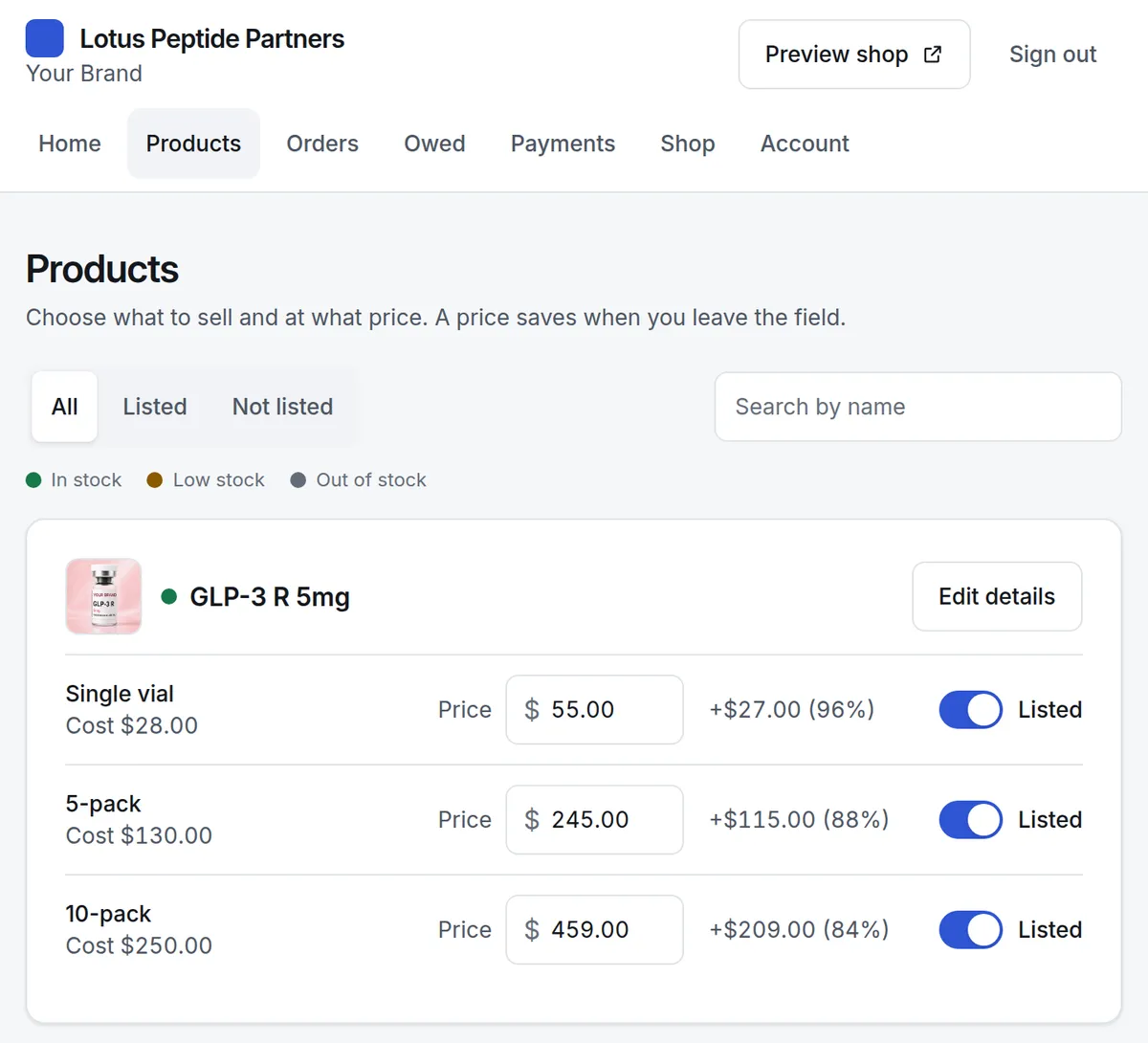
A peptide distributor buys peptides in volume from a supplier and resells them to shops or buyers, so the classic route needs money for a bulk order, a place to store it and a way to ship. A second route skips the bulk buy: you sell through a partner store with no minimum order, pay per order once your buyer has paid, and the supplier ships.
What does a peptide distributor do?
A peptide distributor buys peptides in volume from a manufacturer or supplier, keeps them in storage, and resells them in smaller quantities to shops, labs or individual buyers. The margin comes from the gap between the volume price and the resale price.
Sitting in the middle means carrying the middle's work. A distributor commits money to a large order before selling anything, finds room to keep it, tracks which units came from which batch, packs and ships each sale, and collects payment from the shops it supplies.
It also means carrying the risk: when demand slows, stock already paid for waits on a shelf, and the money tied up in it cannot work anywhere else.
How does bulk wholesale compare with distributing with no minimum order?
The classic bulk route against selling through a partner store that holds the stock, row by row.
| Classic bulk wholesale | Partner store, no minimum | |
|---|---|---|
| Minimum order | Usually a set minimum quantity | None; an order can be a single pack |
| Money up front | The full price of the stock, before your first sale | Nothing for stock; you pay per order after your buyer pays you |
| Your unit cost | A volume price in return for committing to quantity | Your cost per pack, shown in your panel from the first pack |
| Storage | Your own space, which you arrange and pay for | None; the supplier holds the stock |
| Packing and shipping | You pack, label and ship every order | The supplier packs and ships; you buy the postage label |
| Unsold stock risk | Yours to store, discount or write off | None to hold |
| Who you can sell to | Whoever you reach through your own channels | Anyone, including other shops, through checkout on your store |
| Your brand on the product | The supplier's label, unless you arrange your own | Your label on every vial and your brand on the package |
| Batch testing records | Depends on the supplier | A third-party certificate of analysis (COA) for every batch |
How do you become a peptide distributor without buying bulk?
Six steps take you from picking your buyers to a shipped order, and none of them asks you to pay for stock in advance.
-
Decide who you will sell to
Choose your buyers first: people who already follow your brand, labs, or other shops looking for a supplier. Your store name, your prices and where you promote all follow from that choice.
-
Apply
The form asks for a brand or store name, the places you mean to sell, an estimate of monthly orders, an email address and a phone number. You agree to the partner terms; each application is reviewed and answered by email.
-
See your cost per pack
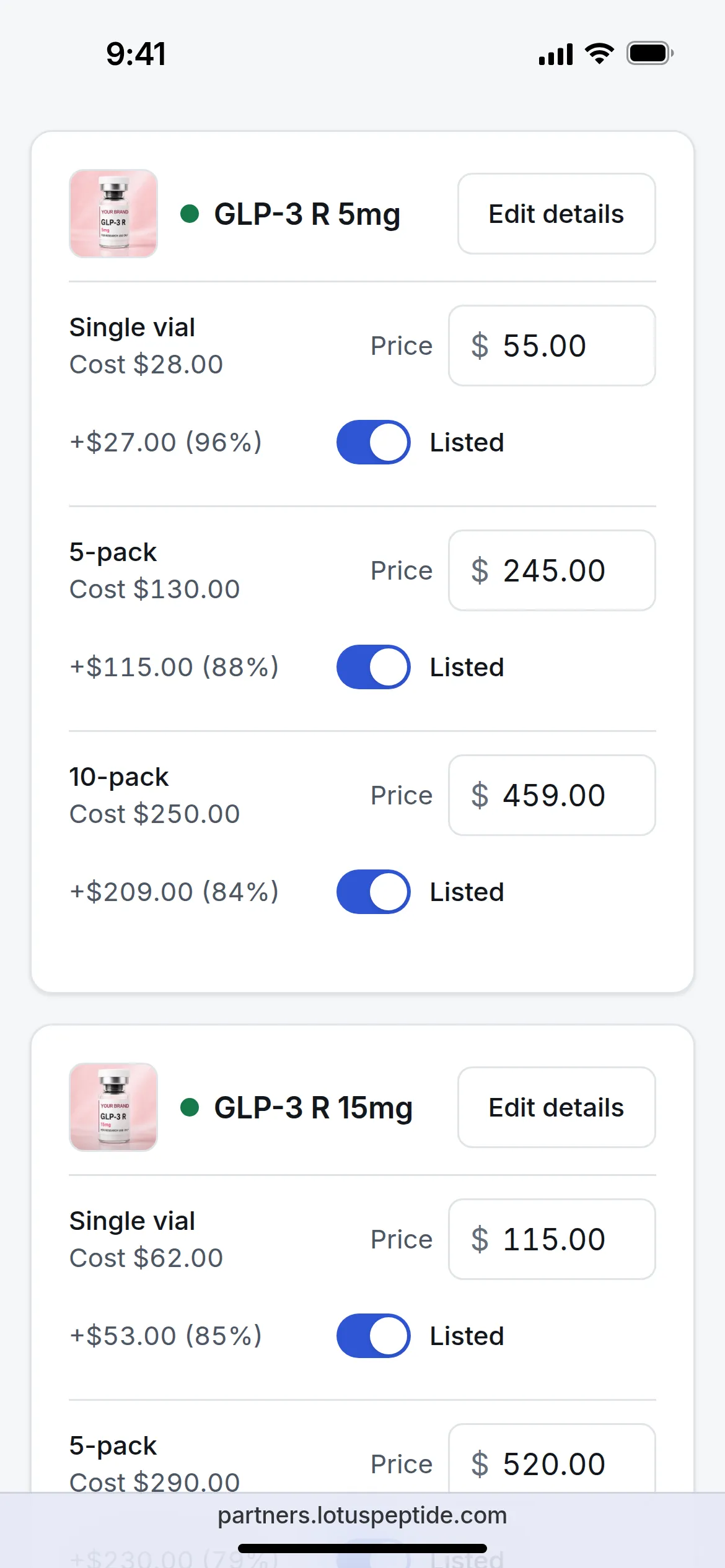
Once you are approved, your panel lists your cost for every pack in a catalog of about 30 research peptides. That is your buying price, the number a bulk distributor would only get by committing to volume.
-
Set your prices
Type your own price beside each cost. If you plan to supply other shops, leave room for their margin as well as yours; direct shoppers simply see your retail price.
-
Sell through your checkout
Shoppers and other shops order on your store and pay you by the methods you switch on, such as Venmo, Zelle, Cash App, PayPal or crypto. See how selling peptides online works from your own store for the shopper's side.
-
Pay per paid order; we ship
When a buyer has paid, you pay for that order from the panel and buy its postage label on Pirate Ship, a postage site. The label gets attached, the order is packed under your brand, and it ships.
Can you sell peptides to other shops as a distributor?
Yes. You may sell to anyone, including other shops and businesses, provided every order is placed through checkout on your own store.
A shop's order is priced like any other, every buyer agrees the products are for research use only, and each package goes out with your label on every vial and your brand on the box. That is the part of classic distribution this model keeps: supplying other sellers, without a storeroom behind you.
What does ordering without a bulk buy look like?
You buy one order at a time, after it is sold: there is no volume tier to reach and no minimum, so a single pack is a complete order.
The sequence is the reverse of wholesale. Your buyer pays you first; then you pay for that order's packs plus a fee of $3.50 per order, plus $1 per product, and the order is packed and shipped. A quiet month costs you nothing in stock, where a bulk buyer would still be sitting on everything bought for it.
What does a peptide distributor pay per order?
Your cost for the order's packs plus $3.50 per order, plus $1 per product. Postage is separate: you buy the label yourself and see its price first.
- Monthly fee
- $0
- while we launch (plans start at $399/month)
- Per order
- $3.50
- plus $1 per product
- Minimum order
- None
- order one pack at a time
- Ships to
- US
- addresses in the United States
A single vial or a 10-pack each count as one product. The fee covers packing, labeling every vial with your brand, and preparing the package.
Example margin on one GLP-3 R 5mg, 5-pack
- Your price, for example
- $245
- Your cost
- − $130
- Fees: $3.50 + $1
- − $4.50
- You keep, before postage
- $110.50
Example only, not a guarantee of earnings. Postage and payment fees are extra, as are your own costs; your results depend on your prices and your customers.
Who does distributing with no minimum order fit, and who does it not?
Distributing with no minimum fits brands and sellers who already have buyers and want no stock risk; it does not fit selling outside the US, needing stock in hand, or marketing for anything but research.
Good fits include a brand with a following that wants its own label, a seller who supplies a few smaller shops, and anyone testing demand before committing real money.
Orders ship to US addresses only, and if your plan depends on keeping your own inventory, classic wholesale suits you better. Products are sold for laboratory research use only, so descriptions say what a product is, its packs and its price, never how to use it or what it does.
Licensing, business structure and tax differ by state; treat anything here on those topics as general information, not legal or tax advice, and check with a lawyer or accountant.
How does the Lotus Peptide partner program fit a distributor?
The Lotus Peptide partner program is one way to run the no-minimum route: you get your own peptide website store, which we build and host on your own domain; the stock stays with us, and every order leaves packed under your brand.
Each month you pay $0 while we launch (plans start at $399/month). Shopper emails come from your own domain, every batch is tested by an independent lab, and you can look up any batch in the published batch certificate library before you sell it.
If the shipping side is what you want to understand first, read how peptide dropshipping works. When you are ready, apply to become a partner.
What do people ask about becoming a peptide distributor?
Straight answers on reselling, cost and approval.
Do I need a license to become a peptide distributor?
Rules differ by state and by what you sell, so this is general information, not legal advice: ask a lawyer where you operate. On this model, products are sold for laboratory research use only, and every buyer agrees to that at checkout.
Should I form an LLC before distributing peptides?
Many sellers set one up to keep business and personal money apart, but whether it suits you is a question for a lawyer or accountant, not a rule. Our guide to starting a peptide business step by step covers the other groundwork.
What is the difference between a peptide distributor and a reseller?
A distributor buys stock in volume and keeps it, so its risk is product paid for but not yet sold. A reseller sells without holding stock up front. Distributing with no minimum sits closer to reselling: you still set prices and supply buyers, but nothing waits on your shelf.
How do I check the quality of what I distribute?
Each batch is tested by an independent lab, for example Kovera Labs or Freedom Diagnostics, which issues a third-party certificate of analysis. The published certificates are searchable by batch number and show purity, the lab and the test date.
Can the products carry my own brand?
Yes. Each vial ships with your label on it, and each package ships with your branding and your own packing slip. You can upload your own product photos, and your shop never names the supplier behind it.
Is this peptide wholesale in the USA?
Not in the bulk sense, because there is no case or volume to buy. Approved partners see a cost for every pack and pay it order by order, with the fee, and orders ship to US addresses only.
How is a peptide distributor different from an affiliate?
An affiliate sends buyers to someone else's store and earns a commission; the seller sets the price and owns the sale. A distributor sets its own prices and sells to its own buyers. Compare the two in our peptide affiliate program guide.
Apply for your peptide website store
Every application is reviewed; approved partners get the panel to set up their store.