A shopper pays you
The order comes in through your peptide website store and the shopper pays you; you owe us nothing yet.
 Lotus Peptide Partners
Every application is reviewed.
What peptide dropshipping is, how it compares with wholesale, warehouses and affiliate links, and what to check in a supplier.
Watch the 1-minute tour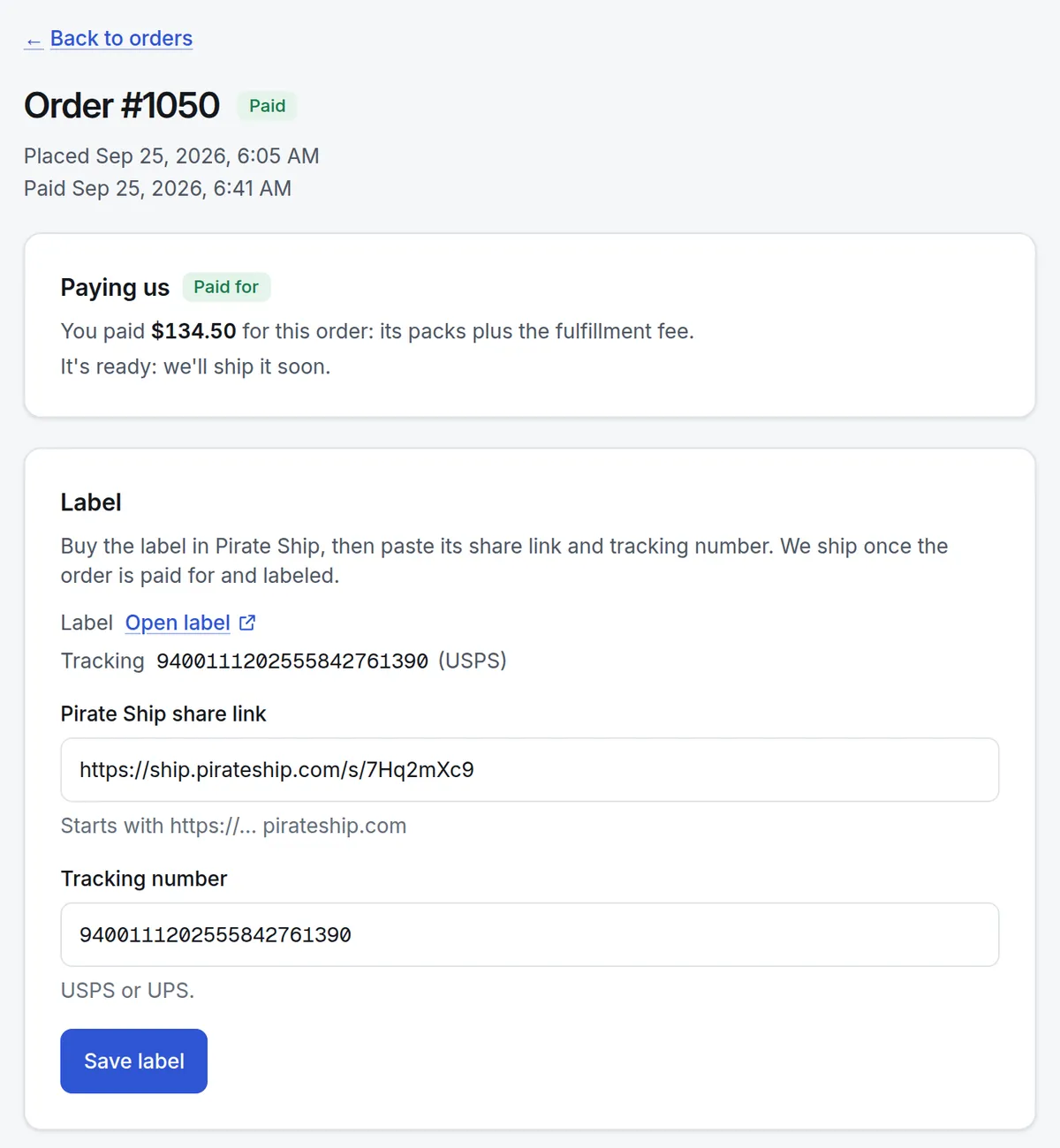
Peptide dropshipping is a way to sell research peptides from your own store without holding stock: the supplier keeps the vials, packs each order and ships it to your shopper, while the shopper buys from you and pays you. You pay the supplier per order, after the sale, so nothing is bought ahead. That sets it apart from becoming a peptide distributor, who buys and stores stock first.
Peptide dropshipping is a retail setup in which you sell research peptides from your own store while a supplier holds the inventory and ships each order straight to your shopper. The shopper pays you, not the supplier.
The money moves in two steps. Your shopper pays your price at your checkout. You then pay the supplier its price for the packs in that order, plus any per-order fees, and the supplier sends the parcel. The gap between the two is your margin, before postage and payment costs.
The supplier owns, stores, packs and ships the stock. You own the customer side: the store, the prices, the brand and the replies to shopper questions. A product that never sells costs you nothing.
Research peptides add two concerns: proof of what is in each vial, and how the products may be described and sold. Both are covered below.
Five common setups, compared on who carries the stock and the work. Terms vary from one supplier to the next.
| Who buys the stock | Who stores it | Who packs and ships | Money needed up front | Who runs the storefront | |
|---|---|---|---|---|---|
| Dropshipping | The supplier | The supplier | The supplier | Low: you pay per order, after each sale | You |
| Bulk wholesale | You, in quantity | You | You | High: stock is paid for before it sells | You |
| Third-party logistics (3PL) warehouse | You | The warehouse, for a storage charge | The warehouse, for a charge per order | High: stock, plus warehouse charges | You |
| Done-for-you store package | Depends on the package; often you | Depends on the package | Depends on the package | Often high: a setup charge, sometimes stock too | The seller builds it, then you run it |
| Owning nothing (affiliate link) | Nobody on your side | The brand you promote | The brand you promote | Little or none | The brand; you send it visitors |
One order, from your shopper’s cart to a tracked parcel, in an example shop and a demo panel.
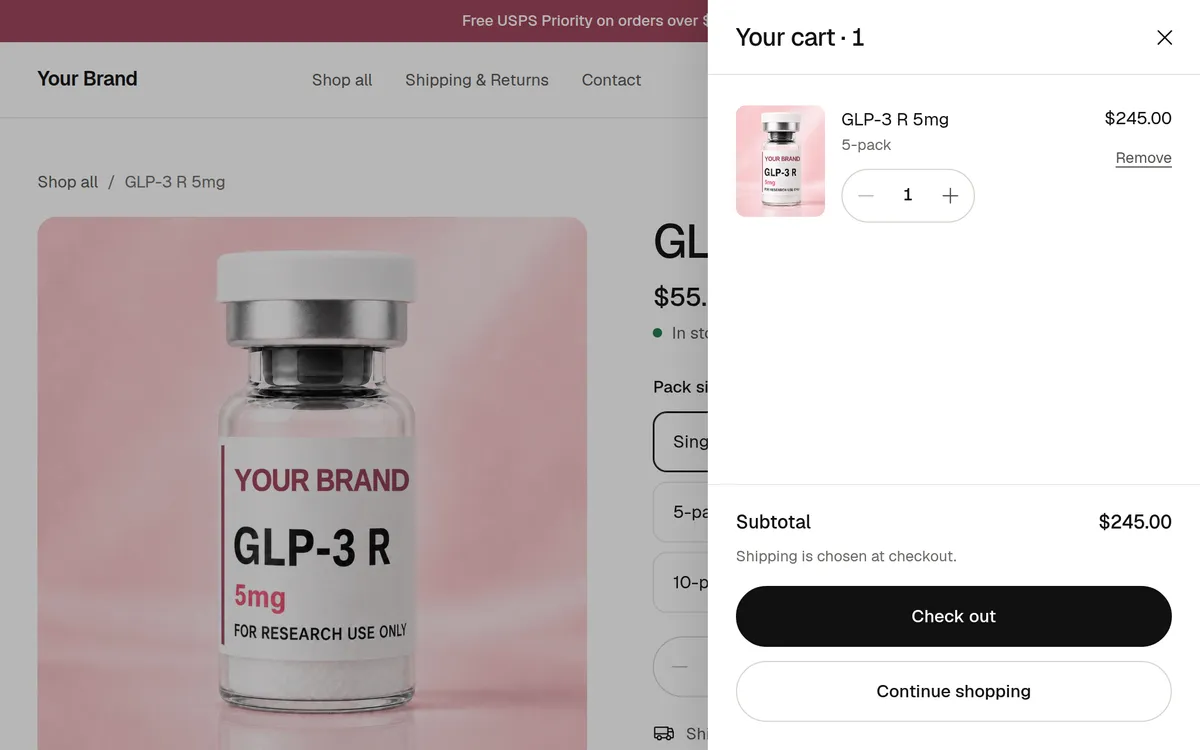
The order comes in through your peptide website store and the shopper pays you; you owe us nothing yet.
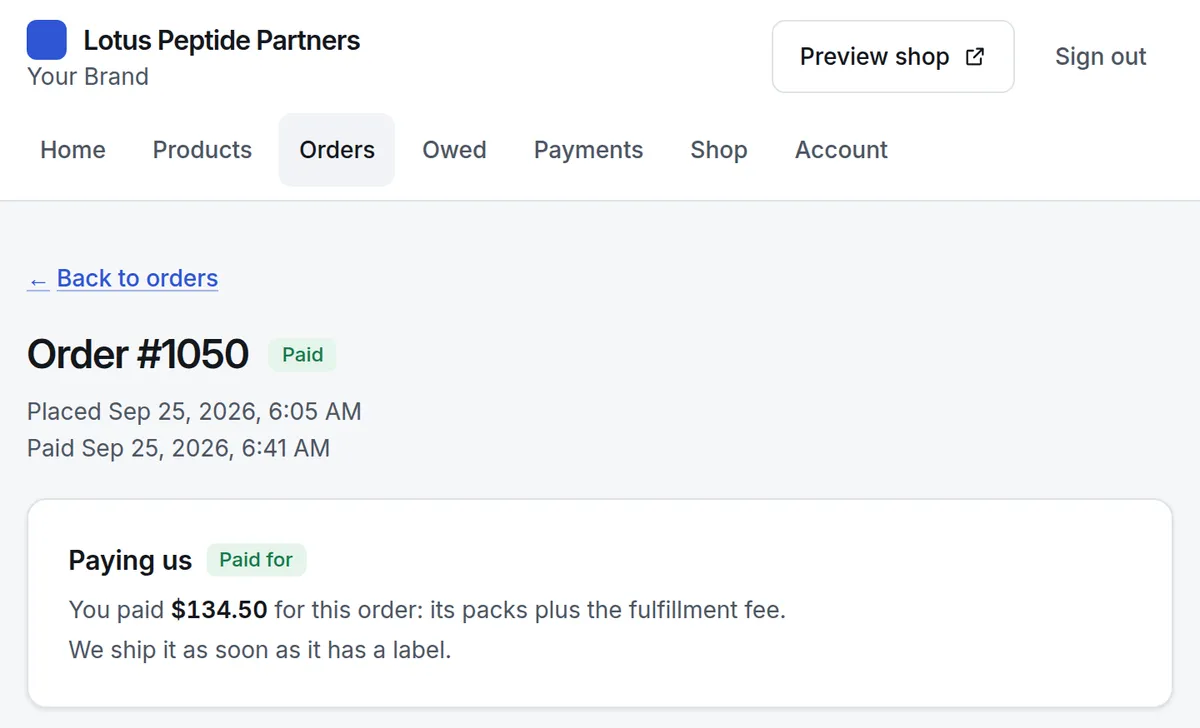
The order in your panel shows what you owe: your cost for its packs, $3.50 for the order and $1 per product.
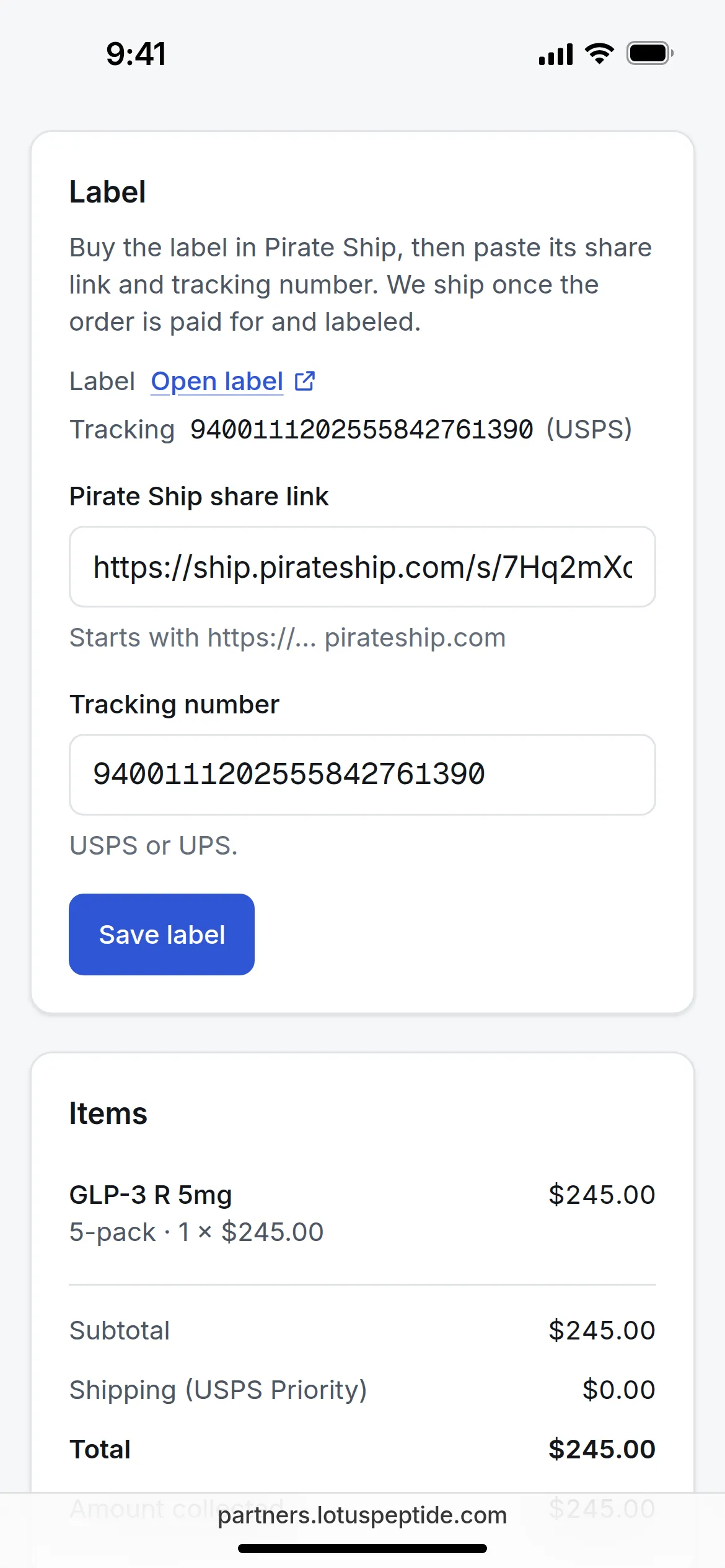
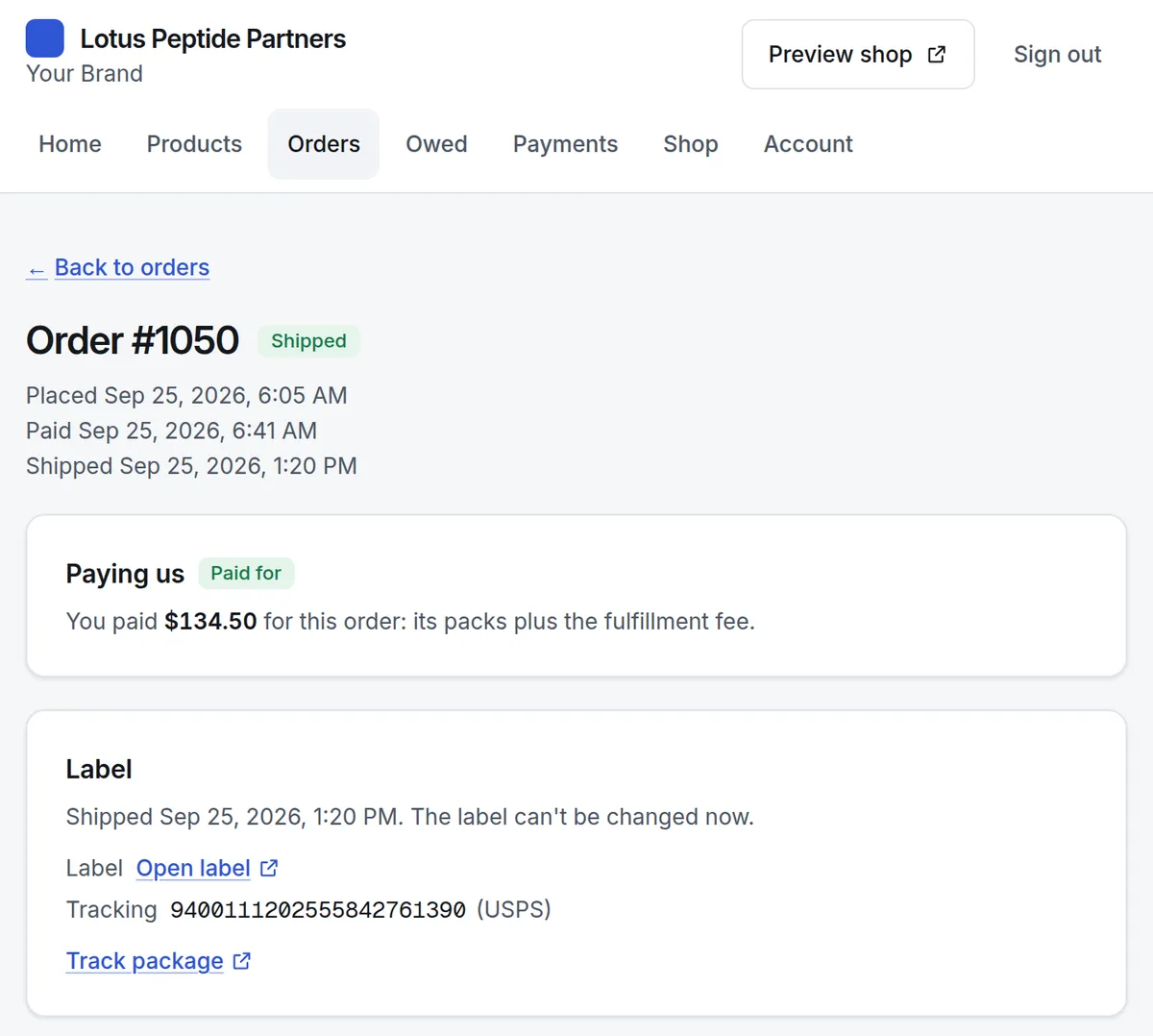
Buy a shipping label on Pirate Ship, a postage site, addressed to your shopper, then paste in its link and tracking number.
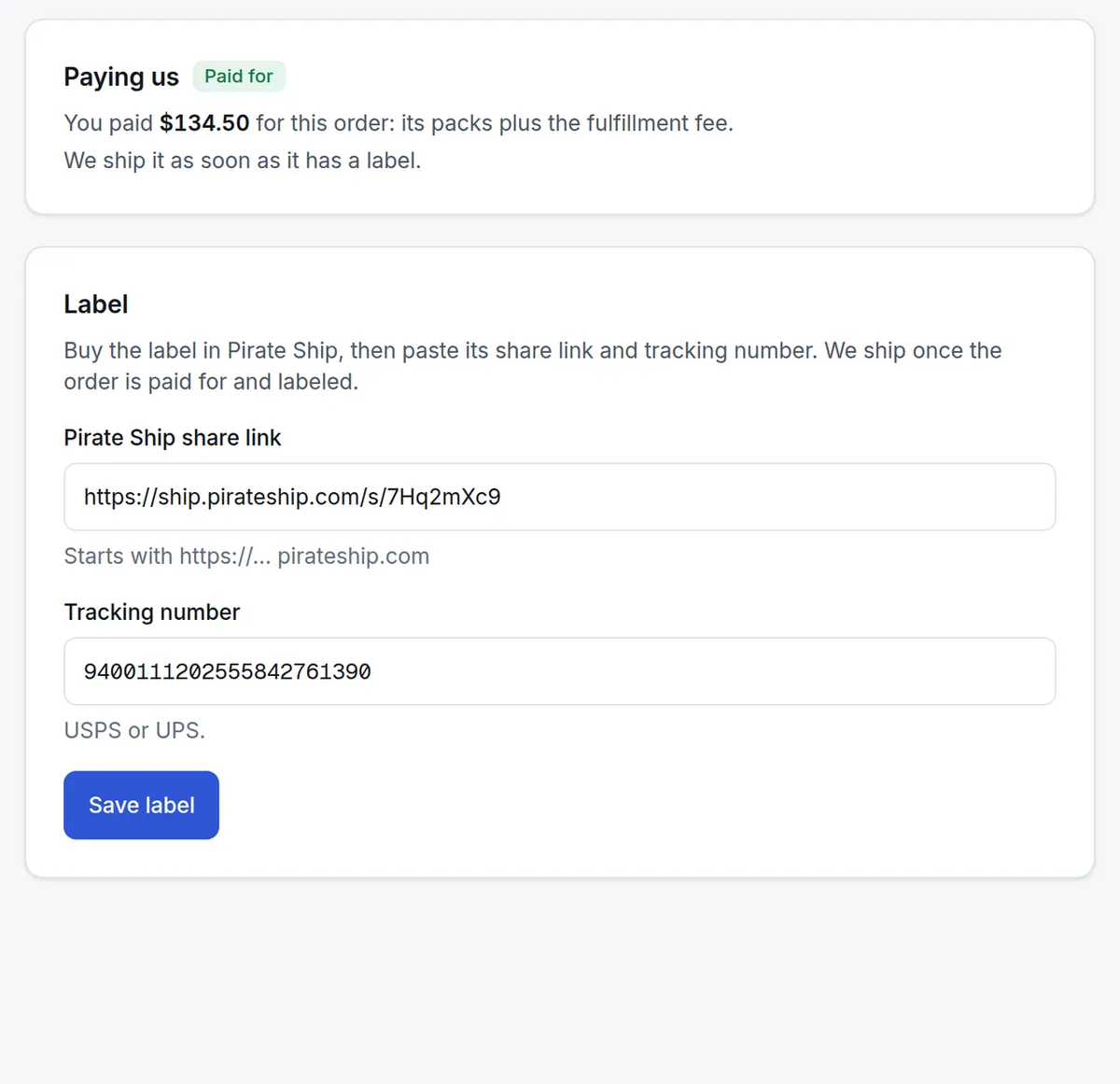
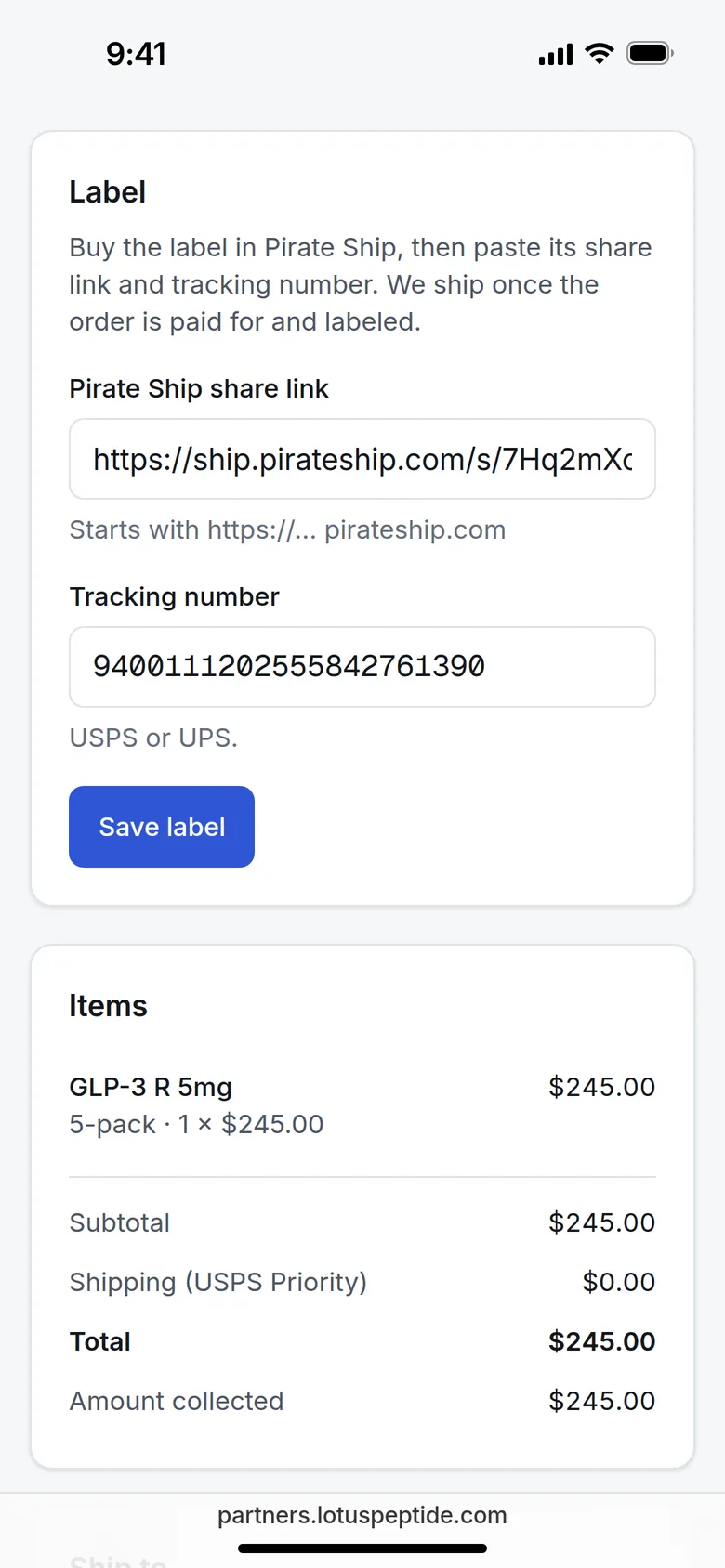
Your vials carry your label, the package carries your brand and packing slip, and we ship it with your shipping label.
Look for batch testing you can check, US shipping, no minimum order, your brand on every vial and parcel, fees you can see, postage priced before you pay, and a written partner agreement.
Testing comes first. Ask for a third-party certificate of analysis (COA) from an independent lab for every batch, with lookup by batch number. One sample report per product is not enough: a certificate speaks only for the batch it tested.
Next, shipping and minimums. The supplier should ship to US addresses and send a single pack as readily as ten; a minimum order or deposit is closer to wholesale.
Then branding: your label on every vial, your brand and packing slip on the package, and the supplier's name nowhere a shopper can see it, or the first parcel tells shoppers where to buy direct.
Then money: per-order fees written down and shown on each order, and postage quoted before you buy it, never added to a bill afterward.
Last, a documented partner agreement saying what the supplier does, what you do, and how the products may be described and sold. A supplier with none to show you has answered the question.
Dropshipping itself is a common way to run a store; with research peptides, legality turns on how the products are labeled, described and sold, and where they ship.
Products in this category are sold for laboratory research use only. A careful shop has an age check at the door and a visible research-use notice, delivers to US addresses only, and keeps product pages to the product, its packs and its price, with no directions for use and no claims about effects.
Payment providers have rules too: Stripe's restricted businesses list prohibits incorrectly labeled research chemicals. Other platforms set their own policies, so read each one's current terms.
This is general information, not legal advice. Rules vary by state, so check with a lawyer about the places you plan to sell.
It depends on the supplier; in the Lotus Peptide program you buy the postage, and we print the label, attach it and ship the parcel.
You buy the label on Pirate Ship, a postage site, addressed to your shopper, seeing its price before you pay; postage is never part of our fee. Then paste the label's link and tracking number into the order in your partner panel.
We pack the order, label every vial with your brand, add your packing slip, attach your shipping label and send it. Your store emails the tracking number from your own domain, and each order has its own page showing progress.
In our program, you pay for each paid order's packs at your cost, plus our fee. Postage is the label you buy.
A single vial or a 10-pack each count as one product. The fee covers packing, labeling every vial with your brand, and preparing the package.
It is dropshipping with the store included: we build and host a peptide website store on a domain you own, hold the stock, and ship every order it takes.
Through the Lotus Peptide partner program you choose from about 30 research peptides, set your own prices, and shoppers pay you directly by the methods you switch on. After a paid order you pay us from the panel: your cost for the packs plus $3.50 per order, plus $1 per product. Your plan costs $0 while we launch (plans start at $399/month), and there is no minimum order.
Every batch we stock is tested by an independent lab; the batch certificate library lists each one's purity, lab and test date by batch number.
Plain answers on stock, labels, branding and shipping.
No. Orders in our program ship to US addresses only, so a store built on it can sell only to shoppers in the United States.
No. The vials wear your label and the parcel shows only your brand, with your own packing slip inside. Partner shops never name Lotus Peptide, and order and shipping emails come from your domain through your own Resend account.
That depends partly on you. We pack and ship once you have paid us for the order from your panel and pasted in the Pirate Ship label link and tracking number, so doing both promptly keeps things moving.
Nothing ships, and you owe us nothing. With manual methods such as Venmo or Zelle, an order counts as paid only when you mark it paid, and you pay us only after that. Until then, no pack leaves our stock for that order.
They pay you, by whichever methods you enable, from Venmo, Zelle, Cash App and PayPal to cash in person, hand-sent crypto or automatic crypto checkout via your own NOWPayments account. Card payments aren't available yet. More in how to sell peptides online.
Yes, as long as every order goes through checkout on your own store and every buyer agrees the products are for research use only. A business buyer orders the way any shopper does, and its parcel ships the same way.
A domain you own for your store, and an application: your brand or store name, where you plan to sell, a rough monthly order count, an email address and a phone number. For the full budget, see what it costs to start a peptide business.
It depends on how much you want to own. An affiliate is paid a commission for sending visitors to someone else's store and sets no prices. Dropshipping gives you your own store, prices and customers, and the work of running them. See how peptide affiliate programs work.
Every application is reviewed; approved partners get the panel to set up their store.